How to Choose the Right JBC Soldering Tip – A Practical Guide

How to Choose the Right JBC Soldering Tip – A Practical Guide
Finding the Best Tip for the Job
Selecting the correct soldering tip is one of the most important factors in achieving reliable, high-quality solder joints. With so many shapes and sizes available, it can be difficult to know where to start. Each tip is designed with a specific purpose in mind, and choosing the right one will not only improve your results but also increase efficiency and reduce the risk of component damage. At V Tech SMT, we regularly help customers identify the best tip for their application, whether it’s precision electronics work or more demanding industrial tasks.
Where to Start?
Before selecting a JBC tip, it’s essential to understand the nature of the job. Consider whether your work involves fine detail, general soldering, or techniques such as drag soldering. The level of precision required will heavily influence your choice, as will the size of the components and pads you’re working with. It’s also important to ensure that any tip you choose is fully compatible with your soldering station and handpiece. Taking a few moments to assess these factors will save time and improve performance in the long run. If you’re unsure, V Tech SMT can provide guidance tailored to your setup.
Common JBC Tip Types:
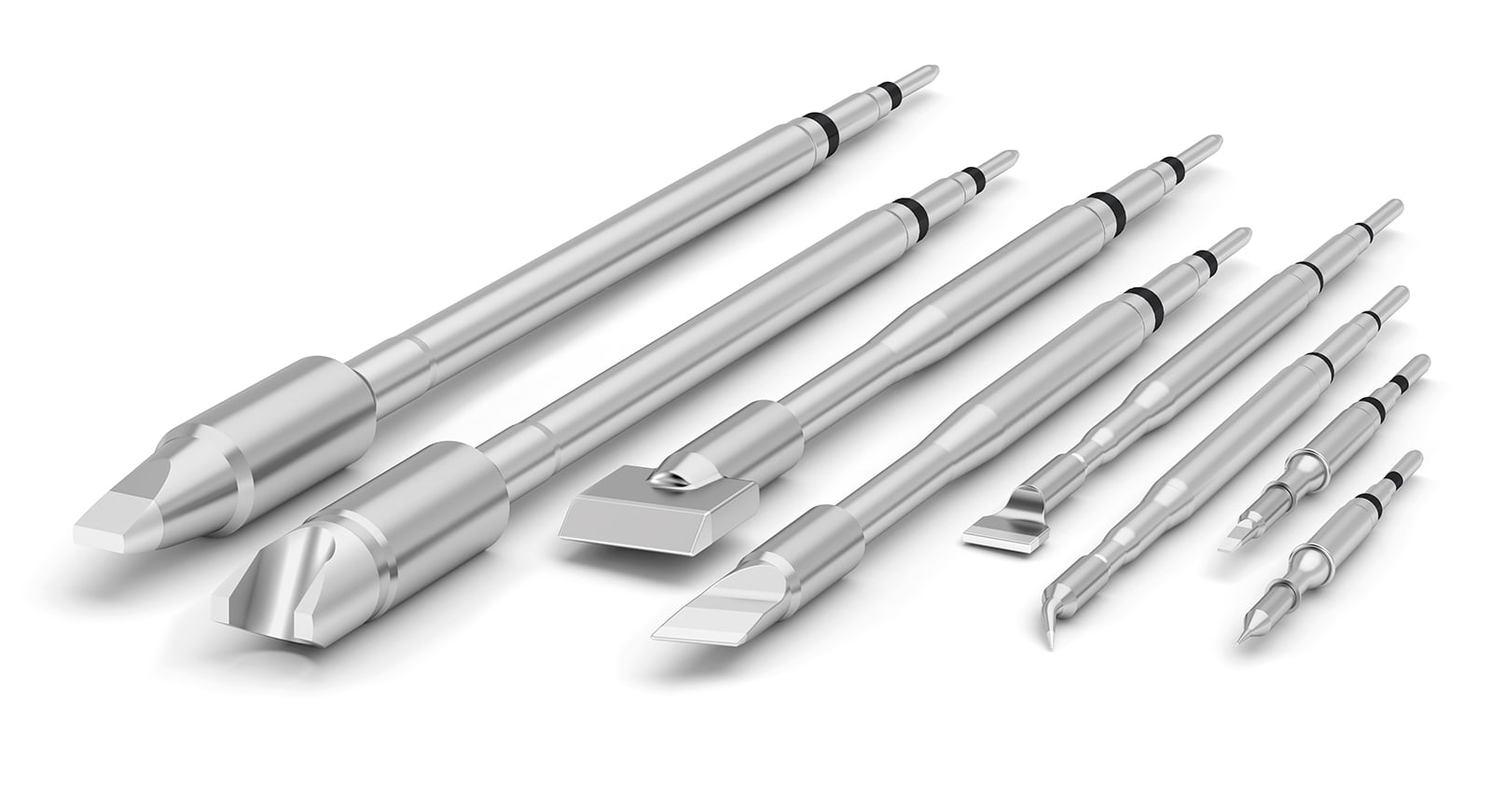
Chisel tips - are the most versatile and widely used. Their flat edge provides excellent heat transfer, making them suitable for general electronics work, wires, through-hole components, and larger SMDs. For best results, choose a tip width around 50–70% of the pad size.
Conical tips - are designed for precision. Their pointed shape allows you to focus heat on small areas, ideal for fine-pitch components and tight spaces. However, they require careful handling, as too much pressure can cause damage.
Bevel tips - feature a flat face with a rounded edge and are great for drag soldering. Their larger surface area holds more solder, allowing you to solder multiple pins quickly and efficiently.
In addition to these standard shapes, there are also specialist and custom-designed tips available for unique or demanding applications. These can include blade or knife-style tips for rework, as well as bespoke designs tailored to specific needs. V Tech can assist in identifying or sourcing these more specialised options where required.
Key Considerations:
One of the most important principles in soldering is that larger tips generally provide better thermal performance. A tip with more surface area and mass will transfer heat more efficiently, allowing you to complete joints more quickly and with less effort. In many cases, this can significantly improve productivity. However, it’s important not to go too large—excessive heat can damage sensitive components or lift pads from the PCB.
Versatility is another factor to consider. If your work involves a variety of tasks and you prefer not to switch tips frequently, a chisel tip is often the best all-round choice. That said, for specialised applications, using the correct dedicated tip will always yield better results.
The volume of solder required also plays a role. Techniques like drag soldering benefit from tips that can hold and distribute more solder efficiently. Bevel tips or specially designed drag tips are ideal in these situations, as they simplify the process and improve consistency.
When working on detailed or delicate assemblies, precision becomes critical. In these cases, smaller tips such as conical designs allow for better control and access, ensuring that heat is applied exactly where it’s needed without affecting surrounding components.
For rework and cleaning tasks, blade or knife-style tips can be extremely effective. Their wider edge allows you to remove solder from multiple pads simultaneously, especially when used alongside flux and solder braid. This can significantly reduce the time required for repair or rework processes.
Finally, always consider compatibility with your equipment. Not all tips are designed to fit every soldering station or handpiece, and using the wrong combination can lead to poor performance or damage. Some systems are optimised for precision work, while others are built for heavier-duty applications. If you’re unsure, V Tech SMT can help ensure you select the right tip for your specific setup.
Final Thoughts:
Choosing the right soldering tip is about more than just picking a shape—it’s about understanding your application and selecting a tool that delivers the right balance of heat transfer, precision, and control. By taking into account the type of work you’re doing, the size of the components, and the capabilities of your equipment, you can achieve better results and work more efficiently.
If you need further advice or support in selecting the right soldering equipment, the team at V Tech SMT is always available to help you find the most suitable solution.
Related Posts


Search
Categories
Recent blog posts